Annotation 5 & Experience
2.) Objective: Observe and play an active role in the development of an Individual Family Service Plan (IFSP) for an early intervention client and their family, based on their individual needs and required services.
Activities and Resources
- Research will be carried out through direct observation of the IFSP planning process, which includes meeting, evaluating, and developing a plan through the “Intake” procedures. Direct observation of the procedures will be from the internship supervisor.
- My supervisor, Joy Munson
- The case manager and all other team members involved in the IFSP process
- An IFSP outline.
Evidence
- An overview of the IFSP and the proceedings leading up to it
- A comparison of an IFSP to an IEP
- An IFSP for a client and family which I was present for the entirety of the process-from initial evaluations/intake to Assessments (Mullen) to developing of the IFSP with all team members and watching the IFSP be carried out.
Evidence 1
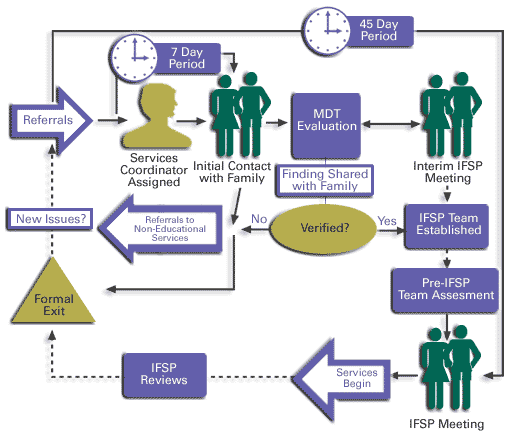
After a child is determined eligible for Early Intervention, the Early Intervention staff and the family design a plan called the Individualized Family Service Plan (IFSP). This plan outlines the child’s strengths and needs. It is developed based on the information gathered from an evaluation or assessment and the concerns and priorities of the family. It includes individualized strategies and supports that can be used to meet the desired outcomes or goals in the IFSP. The plan (IFSP) is reviewed every six months or as needed. Families may request an IFSP review at any time and must agree to any changes that are made in a child’s IFSP.
At Children's Friend and Service, as well as all other Early Intervention Programs, it is desired that all children:
- Demonstrate positive emotional skills, including social relationships
- Acquire and use knowledge and skills; including early literacy skills
- Use appropriate behaviors to meet their needs
In order for families to be successful in caring for their children, we want them to:
- Understand their children's strengths, abilities, and special needs
- Know their rights and effectively communicate their children's needs
- Help their children develop and learn
- Have adequate social support
- Be able to access services and activities available to all families in their communities
Children's Friend assesses how a child is functioning within the three child outcome areas by asking the following questions:
- How does the child compare to their same age peers in each outcome area?
- Does the child use these skills in a variety of settings and situations?
Foundational outcomes are assessed when a child enrolls in EI, and then again when the child is discharged. The assessment process considers all of the information gathered by the team, parent input, information provided by other family members and childcare providers, and skilled observation of the child.
During the IFSP development meeting, which for Children's Friend Early Intervention usually takes place within the child's home, the family and service providers ( i.e. SLP, OT, Special Educators etc) collaborate in order to come up with outcomes for the child and their development. These outcomes are centered around the specific areas in which the family and EI team have addressed as "problem" in which the child is not in the ideal place developmentally they they would like them to be. These goals should aim to address outcomes targeted at family as well as child needs. Not all families will have or want family concerns or outcomes listed on the IFSP. However, when family concerns related to care and raising of the child with special needs have been identified and discussed, every effort should be made to identify possible resources to address them and list outcomes desired to resolve the concern.Before outcomes and overall goals can be put into place, the family and EI team must first solicit a description of the child's abilities and strengths in all areas of development. These include: communication, movement (fine, gross), socialization, critical thinking (cognition), vision, hearing, health, and self-help (adaptive). A statement of ability in each area should be noted on the IFSP form. Then the outcomes are developed. Outcomes should be worded as observable behaviors or products the family and team wishes to see or have in place in 6 months. Furthermore, the outcomes for the IFSP, unlike the IEP in which I have explained in a previous annotation, should be worded to reflect the family's understanding of the the outcome. Federal law does not specify how to phrase the wording of the IFSP outcomes other than to say they should reflect the family's words and wants. This requires that families, services coordinators, and others involved in the IFSP process to engage in conversations about realistic and useful outcomes for the family. Professionals and family members should use this document to reflect on family/child strengths and priorities discussed and agreed to at the IFSP meeting. The frequent review of the document can also assist in guiding future plans, specific actions and discussions about old and new priorities.Below are links to guidelines on how to complete the sections of an IFSP under each states regulations:
Evidence 2
IFSP (Birth to 3) IEP (Ages 3-5) Participation in the Initial and Annual IFSP meetings must include at least: Participation in the IEP meeting must include at least:A statement of the child's levels of development across all developmental domains, including vision, hearing and health. A statement of the child’s present levels of academic achievement and functional performance. A statement of the family’s and child’s strengths and needs, resources and priority concerns. A statement of the child’s strengths and needs, and the concerns of the parents for enhancing their child’s education. A statement of the measureable outcomes expected for the child and family, along with the criteria, process and timeline for determining progress toward each outcome. A statement of the measureable annual outcomes designed to ensure the child participates and makes progress in the early childhood curriculum and participates in appropriate activities with his/her peers. This includes how the child’s progress will be measured and when progress reports will be provided. A statement of services necessary to meet the needs of the child and family including services from education, health and social service agencies as well as informal networks and resources. A statement of special education and related services to be provided to the child, along with necessary program modifications, accommodations, and/ or supports. The projected dates for the beginning and duration of each service including how often, how much, whether it will be group or individual, and where they will be provided. The projected dates for the beginning and duration of each service, including how often, how much and where they will be provided. Services must be provided in the natural environment, that is, home and community settings that are natural for the child’s age peers who have no disability. A written justification must be provided about the extent, if any, to which services cannot be provided in the natural environment. Services must be provided in the least restrictive environment (LRE) to support the child’s participation in the general education curriculum (preschool and other early childhood settings) with his/her peers. A written justification must be provided about the extent, if any, to which the child will not participate in regular early childhood programs and activities with nondisabled children. A listing of persons responsible for implementation of individual services as well as parties (persons or agencies) responsible for payment of services. A listing of individuals responsible for implementing IEP services. Families of infants and toddlers with disabilities are entitled to a services coordinator. _______ The services coordinator should facilitate and articulate steps and support for a smooth transition to preschool-age services, programs and systems if the child is to continue receiving services as part of an IEP. At the request of the parent, the services coordinator must be invited to the initial IEP meeting for a child served with an IFSP to assure a smooth transition of services. The IFSP must be reviewed every six months, or more often if the situation warrants or the family requests it; in addition, a meeting must be held at least annually to evaluate the IFSP for the child and family. The IEP must be reviewed at least annually to determine if goals are being met, or more often if the situation warrants or the family requests it. The services coordinator must make arrangements for IFSP meetings to be held in places and at times convenient for the family. The services coordinator, along with the family, is responsible for arranging the team meeting in places and times convenient for the family, and for facilitating the IFSP. The IFSP may not be held without the family. The school district must take steps to ensure one or both parents of the child is present at the IEP, or are given the opportunity to participate by scheduling the meeting at a mutually agreed on time and place. If neither parent can attend the IEP meeting, the school district shall use other methods to ensure parent participation, including individual or conference telephone calls. Year round continuous services are required such that early intervention services are not interrupted or modified for any reason unrelated to the child’s needs (e.g. service provider availability or scheduling). Extended school year services must be determined by the child’s IEP team as necessary to provide a free and appropriate public education. Parents may decide to accept or decline any early intervention service, and may decline that service after first accepting it, without jeopardizing other early intervention services, on the IFSP. Parents may decide to accept or decline any special education or related service without jeopardizing any other service, benefit, or activity under Rule 51.
Rhode Island Department of Human Services
Early Intervention Program
Child’s Name:
______***** ****_______
DOB: __1____/___12___/__2010____ Gender: Male
Child’s Address ________N/A_______
Parent/Guardian:_____N/A____
Phone # _____N/A_________________Referral Date: ___10___/__17____/__2011___ ID :_____N/A ____
Service Coordinator: ___N/A_________________________
Parent Consultant: ______N/A____________________
Primary Care Physician: _____N/A_________________
IFSP Meeting/Review Date: __11____/___15___/__2011____
(This is the date when the IFSP team meets to begin the development of the IFSP.)
IFSP Start Date: __12___/__1___/_2011____ IFSP End Date: __12___/__1___/_2012____
(The start date is the date the family signs the IFSP in agreement.)
Type of IFSP: Initial
Six Months Review due on or before: __6___/__1___/_2012___
Child’s Name: ___________***** ****___ ID: #__N/A__
About My Child: Where and with whom does your child spend time?
Describe the people, toys, activities, routines, and places your child enjoys the most and the ones he/she finds challenging (If this is an annual IFSP, what’s new? Has anything changed?)
Child is helpful and will help mom with new baby by throwing away baby’s diaper or getting things when he understands what you want. He spends the majority of his time at home with his mom. He especially enjoys playing with a ball. Just before naptime, he becomes very active-hitting and chasing his brothers.
About My Family: You may share as much or as little information as you choose
As a family we enjoy going Chuck E Cheese and going to the parks. We are a very close family.
Family’s Questions for the Assessment:
He presently know/says words but understands everything we say. But he is very active and hits everyone who comes home.
Child’s Name: ___***** ****___ DOB: ___1___/__12____/__2010____
Evaluation Date: __11___/__12___/__2011___
My pregnancy with him was not easy. I was nauseas all the time and had pain all the time and had to wear a pregnancy belt. All of his immunizations are to date and he has no significant medical issues.
Current Health Status:
He is a very healthy child but does have eczema. He is not taking any medication and doesn’t see any specialists. Child’s mom missed the last Drs appointment for physical and will reschedule. He is a good eat and not picky about what he eats.
Child’s Name: ______***** ****________ ID#: _N/A_
Vision Status/ Hearing Status
EI Vision screening completed? Yes (Yes, summarize results. )
Normal
EI Hearing screening completed? Yes (If Yes, summarize results. )
Rhode Island Early Intervention Assessment Summary
Child’sName:______***** **** ID#____N/A____
Introduction
Family’s initial concerns: *Reason for referral *Family’s role during evaluation *Behavioral observation of the child
Cognitive Skills: Playing, Thinking and Exploring
Present levels of development:
*Strengths in this area *Concerns in this area *How does this impact the child’s participation in everyday routines and typical activities? *Are the child’s skills age appropriate?
His cognitive skills are moderately delayed. He was able to look at picture books and opened/closed the book when she chose. He did match 2/4 shapes in a puzzle board but did not match any more objects. He was unable to sort objects by category or by size. It was also hard to determine if he had those skills or not due to his extreme shyness.
Rhode Island Early Intervention Assessment Summary
Child’sName: ***** **** ID#________N/A_________
Gross Motor Skills: Body and Muscle Development, Moving
Present levels of development:*Strengths in this area *Concerns in this area *How does this impact the child’s participation in everyday routines and typical activities? *Are the child’s skills age appropriate?
Fine Motor Skills: Body and Muscle Development, Using Hands
Present levels of development:
*Strengths in this area *Concerns in this area *How does this impact the child’s participation in everyday routines and typical activities? *Are the child’s skills age appropriate?
His fine motor skills are slightly delayed. He was able to stack blocks one on top of another, vertically, but he did not line them on a horizontal plane. He was also able to pick up a small penny and place it in a vertical slot on a bank with no difficulty. After several attempts he was able to make marks on a paper in any direction.
Rhode Island Early Intervention Assessment Summary
Child’sName:________***** **** ID#______N/A_____
Receptive Communication: Understanding
Present levels of development:
*Strengths in this area *Concerns in this area *How does this impact the child’s participation in everyday routines and typical activities? *Are the child’s skills age appropriate?
He was receptive language skills are significantly delayed. He will turn when he is called by his nickname. Will almost always stop when he is told “no.” He also will return items upon request when accompanied by a gesture. However, if the request is not given with a gesture, he will not complete the task. Nor did he identify any objects.
Expressive Communication: Communicating
Present levels
of development:
*Strengths in this area *Concerns in this area *How does this impact the child’s participation in everyday routines and typical activities? *Are the child’s skills age appropriate?
His parents report that he has less than 10 words he uses regularly. He is making vocalizations and playing with sounds, but evaluators did not hear any words. It was difficult to determine his speech levels because he refused to speak during the evaluation.
Rhode Island Early Intervention Assessment Summary
Child’s Name: _______***** ****____________________________________ ID#_________N/A_________________________
Adaptive Skills: Eating, Dressing, Toileting, Sleeping
Present levels
of development:
*Strengths in this area *Concerns in this area *How does this impact the child’s participation in everyday routines and typical activities? *Are the child’s skills age appropriate?
His adaptive skills are age appropriate, he can chew and swallow his food completely. He is beginning to take his shoes off when his laces are loose, but he has not yet begun to put them back on. He is also able to undress himself with assistance but not redress yet. He is more independent and n longer wants to be fed by his parents. He can use a fork and napkin to clean himself now. He sleeps well at night and will only sleep when his parents go to bed.
Social/Emotional Skills: Interacting with Others
Present levels of development::
*Strengths in this area *Concerns in this area *How does this impact the child’s participation in everyday routines and typical activities? *Are the child’s skills age appropriate?
His is a very shy person who loves to control his choices and becomes extremely jealous when others are given attention. However, is comfortable with others, he can separate and go around his house easily. He is trying to be more independent. He is very affectionate towards others, but can have extreme temper tantrums by banging his head on the floor when he is upset. He tried to defend his possessions by grabbing them back and saying “mine”. When he says “no” he means no and refuses to comply unless he wants to.
Rhode Island Early Intervention Evaluation Summary
Child’s Name: ________***** ****_________________________
ID#: _______N/A_________________________
Evaluation Date: ___11___/___15___/_2011___
Disposition:
Eligible
Eligibility:
*Developmental Delay
Methods and Procedures Used:
*Developmental history
*Family report
*Observation of child
* Play-based evaluation
Evaluation/Assessment Used:
Criterion/curriculum based Instrument:
_____HELP______________________________________
Norm referenced Instrument:
_____MULLEN______________________________________
Diagnosis:
Primary Diagnosis: ______MIXED DEVELOPMENTAL DELAY______________________
Participants:
Name: _____EDUCATOR__________________________
Name: _____PHYSICAL THERAPIST________________
Name: _____SPEECH THERAPIST___________________
Name: ________MOTHER_________________________
Results Summary: Results include Standard Score, T-score, developmental age, performance level, or whether or not concerns were identified. (Please note that in general, Standard Scores (SS) between 85 and
115 are considered to be within normal limits, as are T-scores between 40 and 60)
Data Code: 1-7 score may be 1-4, 6. 8-9 should be only 4 or 6.
1. >=2 SD or at least 33% delay 3. Delay<1.5 SD or at least 25% delay 6. No delay or significant findings
2. Delay 1.5 to 2 SD 4. Health Risk or impairment significant atypical findings
Area Reviewed Results Data Code Comments:
|
Area Reviewed |
Results |
Data Code |
Comments |
|
1. Cognitive |
32 |
02 |
Difficulty with matching & sorting objects |
|
2. Gross Motor |
45 |
06 |
Climbing up/down stairs, walking independently |
|
3. Fine Motor |
37 |
03 |
Not imitating patterns, only turning wrist partially |
4.Expressive
Communication
|
<20 |
01 |
Mom/step dad report less than 10 words |
5.Receptive Communication
|
20 |
01 |
Didn’t comply with tasks, hard to determine skill level |
|
6. Social Emotion |
06 |
No Concerns |
|
|
7. Adaptive Skills |
18-29 mo. |
06 |
No Concerns |
|
8. Vision |
No concern |
06 |
No Concerns |
|
9. Hearing |
No concern |
06 |
No Concerns |
Child’s Name: __***** ****__ID#:_______N/A_____________________
Family Concerns and Priorities
Thinking about
all of the information we’ve gathered up until now, what are your current
concerns related to your child’s development?
I am concerned about his language. His behavior is difficult at times. He bit another child and made him bleed. He hits other children.
List any other concerns identified by other team members during the assessment process.
Looking at this list what would you like to focus on in the next few months?
Speech and behavior.
Child’s Name: ___***** ****__ ID#: ____N/A_________ Date __12__/__1__/_2011__
Outcome
What we want to see happen for our child/family as a result of early intervention supports and services:
What is happening now and describe how this impacts your child /family? (Who, What, When, Where, How?)
What will happen? (What will progress look like?/How you will know it is happening or describe the steps toward progress)
Our Strategies: (WHAT strategies, and in WHICH everyday routines, activities and places? What supports does the caregiver need to utilize the strategies?)
2. Name objects he is crying for or grasping for.
3. Provide choices between 2 objects/food and name choices for him.
4. Schedule hearing test.
Review Date: _____/_____/_____ Continue Outcome Change Outcome Achieved Outcome Parent’s initials:_______ Date: _____/_____/_____
Please summarize child’s progress and changes that would be helpful:
Review Date: _____/_____/_____ Continue Outcome Change Outcome Achieved Outcome Parent’s initials:_______ Date: _____/_____/_____
Please summarize child’s progress and changes that would be helpful:
Child’s Name: ___***** ****___ ID#: ______N/A__ Date ___12___/__1___/_2011__
What we want to see happen for our child/family as a result of early intervention supports and services:
What is happening now and describe how this impacts your child /family? (Who, What, When, Where, How?)
What will happen? (What will progress look like?/How you will know it is happening or describe the steps toward progress)
Our Strategies: (WHAT strategies, and in WHICH everyday routines, activities and places? What supports does the caregiver need to utilize the strategies?)
1. Give him direct consequences for his actions. (For example: Time out for 2 minutes and explain to him why he is in timeout.)
2. Clear expectations---define what you want him to do.
Review Date: _____/_____/_____ Continue Outcome Change Outcome Achieved Outcome Parent’s initials:_______ Date: _____/_____/_____
Please summarize child’s progress and changes that would be helpful:
Review Date: _____/_____/_____ Continue Outcome Change Outcome Achieved Outcome Parent’s initials:_______ Date: _____/_____/_____
Please summarize child’s progress and changes that would be helpful:Child’s Name: _____***** ****_______
ID#: _____N/A_________________________
Early Intervention Services
|
EI Services |
Location Code(1-7) |
Natural Setting |
Frequency |
Intensity |
Duration (months) |
|
Section |
|||||
|
Family Counseling |
Home (1) |
Yes |
4/month |
1 Hour |
12 months |
|
Speech Therapy |
Home (1) |
Yes |
4/month |
1 Hour |
12 months |
|
Case Manager |
Home (1) |
Yes |
4/month |
1 Hour |
12 months |
IFSP Update
Date of Change: ____/____/____
Parent’s initials: ________________
Describe changes made to services and reason for the change:
Acknowledgement of the IFSP
I have PARTICIPATED in the development of this IFSP, I have READ this IFSP and/or the contents of the IFSP have been FULLY EXPLAINED to me.
_____ I have been informed of my right to due process and procedures (procedural safeguards).
_____ I understand that Early Intervention services will be paid for by private health insurance, Medicaid, and/or state funds.
_____ I understand that Service Coordination could consist of home visit time, telephone calls, and conversations with other providers.
I can anticipate Service Coordination to be provided _____________________. I understand that this can be amended at any time with agreement from the IFSP Team. (amount of time per month)
_____ I do approve of this plan for my child and family.
_____ I understand that services on my IFSP should start within 30 days of my signature, unless there is a justified reason indicated.
IFSP Team Members:
Parent/Guardian Signature:________________________________ Date: ______/______/______
Service Coordinator:_____________________________________ Date:______/______/______
Other Team Member:____________________________________ Date:______/______/______
Other Team Member:____________________________________ Date:______/______/______
Other Team Member:____________________________________ Date:______/______/______
~For Interim IFSPs Only~
I have participated in the development of this Interim IFSP and agree to its implementation. I understand that an Interim IFSP is a temporary plan developed for children who are eligible for Early Intervention and are in need of immediate services. I also understand that a full IFSP still needs to be completed.
Parent/Guardian Signature:______________________________ Date:_____/_____/_____
Service Coordinator:___________________________________ Date:_____/_____/_____
