Annotation 3 & Experience
Objective: Learn how to produce an IEP and how to participate in a formal IEP meeting.
§ Activities and Resources:
v Work with supervisor and other special education teachers, learning what an IEP is and how they are produced.
v Manual and online research on the development of an IEP.
v Work with supervisor and special educators in producing an IEP.
v If possible, sit in on an IEP meeting and observe.
§ Evidence:
v Produce an overview of what an IEP is and the reason we have them.
v Provide an outline of IEP Meeting Procedures
v Provide
a copy of IEP.
IEPs are a huge part of the learning process for certain students. I have learned throughout the course of my schooling that everyone, no matter how intelligent they may be, learns at a different pace and in different ways. This is what makes people unique. Although many students may be in a classroom, all striving to learn the same things, each and every one of those students has a different understanding and comprehension of what they are being taught. Some students learn at a fast pace and are able to "pick up" on new ideas and concepts quickly while other require more attention and assistance. It is because of this, that we have IEPs. As I will describe later, IEPs are Individualized Education Plans. They cater to the needs and deficiencies of specific students.
Perhaps the biggest, most important concept that I learned from this specific objective, is that IEPs are a process. They are not, by any means, one solution to one problem that is able to be fixed overnight. They are a well thought-out, well-planned, and carefully administered process that requires the input from multiple parties, including but not limited to the student themselves, the parents or guardians of the student, the teachers, the special educators, and specific therapists such as a Speech-Language Pathologist. Without IEPs, students would not be able to be serviced or treated properly and could run the risk of falling behind without the hopes of catching up. It is because of the team of people that are part of an IEP process that students are able to receive the help they need within the proper environment and are able to go forth with their education as planned.
Throughout my internship experience, I learned more and more on a daily basis the importance of IEPs. It was so rewarding to observe students, having known what their "Goals and Objectives" were ahead of time, achieving said goals and objectives. Within IEPs, as I will explain later, their are "Benchmarks" set for students. These are guidelines for which the student will hopefully achieve certain goals are decided based on the student's "Present Level of Functioning" and the types of services, such a Speech Therapy, they they will receive. It was truly wonderful to watch students achieve their goals. Even from the start of my internship, which was in January until May, I continued to see improvements in students on a daily basis. It was the "little things," such as hearing and observing a student properly articulate certain speech sounds or seeing the "light bulb" turn on when they understood a concept that they previously had difficulty with. To me, this was the best part of my internship, seeing students make the progress they they hoped to make. Even if it was small amounts of progress at a time, it was still beyond rewarding. It is because of IEPs that the students were able to achieve these goals. IEPs are "individualized" and are for the benefit of the student and their future learning.
I believe that all of my classes from the Communicative Disorders Department provided a solid framework for my achievement of this objective. Classes such as "Introduction to Communicative Disorders" were my first exposure to the field. They gave me a starting point by introducing new information while allowing me to draw upon information I wasn't aware I knew. Speech Science, Hearing Science, Phonetics, Language Development, and Neuroanatomy laid the groundwork for understanding where specific disorders come from, why they occur, and what possible solutions there are for correcting them. These classes gave an overview of disorders and deficiencies that I will be seeing in my everyday life as an SLP. Through my internship, I was able to apply my knowledge that I had gained in these classes, as well as many others. I was able to understand why certain students learn the way they do. Through my observations at my internship, I was able to take what I had previously learned and apply it to the new skills I was learning, such as the process of developing and writing an IEP.
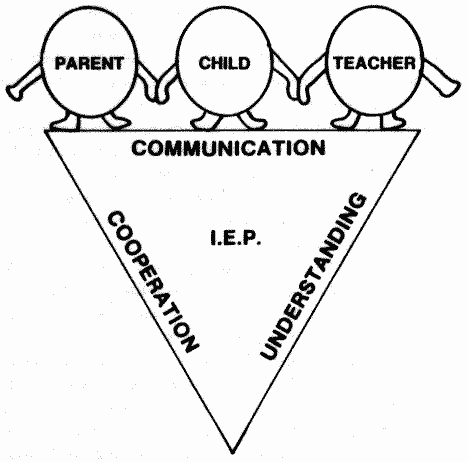
Evidence 1.
What is it?
An IEP is an Individualized Education Program. It is mandated by IDEA- Individuals with Disabilities Education Act. It is a document, defined by federal regulations, that is designed to meet the unique educational needs of a child. It provides accommodations and modifications for individual students to meet educational goals. The goals are based upon state and national educational standards. The document provides benchmarks, or steps to be taken, to help the students reach the goals. All goals must be observable and measurable. Goals and benchmarks must correspond to the needs of the student. The IEP describes how the individual students learns, how they demonstrate these skills, and what service providers (teacher, SLP, OT etc) will do to teach the student in the most effective and productive way possible. All this leads to the placement of the student in the (LRE) Least Restrictive Environment possible for the student. Remember, LRE is not a place. It is unique to each child, their needs and abilities. All children should have the opportunity to be educated with non-disabled peers to the greatest extent that is appropriate.
Why do we have IEPS?
To write an IEP, a student must first be found eligible for services under a particular eligibility. Criteria for eligibility are different between states. Students must be assessed in all areas regarding the known disability (i.e. If a student is found eligible for special education under the category of Developmental Delay-in specific states- you must assess their skills in 5 domain areas-Self-help, fine motor, gross motor, social/behavioral, receptive and expressive language.) This assessment is done through formal and informal evaluations. For speech, you have a whole battery of tests/assessments that you conduct with students depending upon their age, diagnosis, and ability level. For example, you wouldn’t perform a test measuring expressive language on a non-verbal student and so on. You also have to evaluate the student’s ability to access the general curriculum-how their disability is affecting their learning.
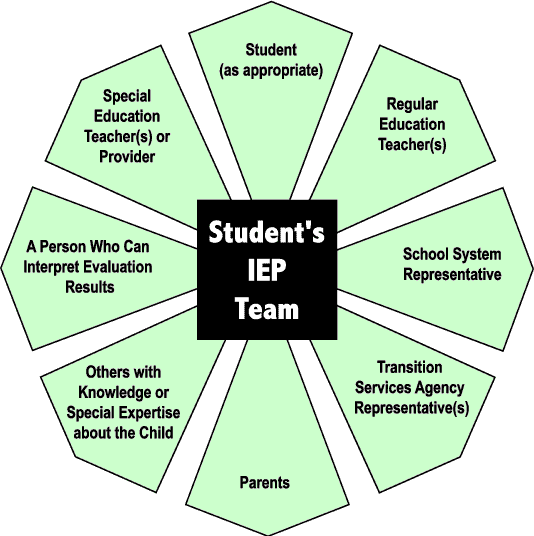
Evidence 2
1. Introductions
2. Procedural Safeguards
This includes Privacy items, testing timelines, parent/guardian and student's rights.
3. Personal Information
Are phone number, addresses, parents’ names, birth date etc. correct on all forms?
4. Progress Monitoring
This is the rate of progress the student has made towards goals and objectives.
5. Current Present Levels
This is the level at which the student is currently performing at. Also, typical peer present levels-i.e. where a typical child is at
that particular age is discussed at this time.
6. Special Factors
This is where special and extenuating circumstances would be noted. This might include assistive technology, and or
necessary equipment a child may require for a disability.
7. Goals and Objectives
This is the area that an IEP is centered around. These goals and objectives are the educational plan for the child for a particular
span of time.
8. Related Services
These services might include Speech/Language Therapy, Physical Therapy, Occupational Therapy, Counseling etc.
9. Accommodations
These are adjustments made to the child's IEP to ensure the child will be successful.
10. Placement
Placement is where the child will be best serviced in a classroom, program, and school.
11. Medicade Form
A Medicade form is necessary and required to be filled out to ensure payment is made to the school department.
- Make appropriate number of copies and distribute to appropriate parties/departments (according to district). This might include ESY, Case Management, Special Ed. Dept. etc. This is to make sure that all parties involved in the child's IEP have a copy and proper documentation of the current Individual Education Plan for the child.
- Distribute IEP/Behavior Intervention Plan to appropriate personnel. Appropriate personnel - i.e. art teacher, music teacher, would receive a copy of the intervention plan so that when the child is under their supervision, they have required information to best service the child.
- File original copy. The original copy is kept in the Special Education Office of the district in confidential folder. It is signed by the parent and all team members and attendees of the meeting.
- Document in status record that meeting was held along with pertinent information. This document is signed and dated to record all meeting participants. It is also kept in the confidential folder.
- Follow up with any student schedule changes (if needed). These changes might include class and related service changes.
- Follow up with any assessment referrals (if necessary). If the child required additional testing and assessments, the team would reconvene and decide what specific evaluations are needed.
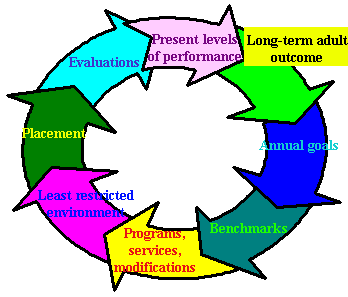
Evidence 3
For the actual IEP, there would be a cover page stating the students personal information, parental information, and the purpose of this IEP. In this case, it is for an annual re-evaluation of this student's IEP. I have chosen to leave all of this information out, as well as the participants in the meeting and dates, for confidentiality purposes.
| Present Levels of Functional Performance | |
| Strengths | Needs |
| Student has average receptive and expressive language skills. | Student requires cues to use correct pronouns and noun/verb agreement in connected speech. Student demonstrates with articulation errors of the /ch/ and /sh/ phonemes. |
| Areas to be Addressed During the Timeframe of This IEP | |
| Academic: n/a | Functional: Articulation Verbal Expressio |
| Areas to be Addressed During the Timeframe of This IEP For Preschool Student | |
| Academic Standards Student's Program Will Address | |
| RI Early Learning Standards | |
| Grade Level Expectations | |
| Grade Span Expectations | |
| WIDA English Language Proficiency Standards | |
| Alternate Assessment Grade Span Expectations (attach the completed Participation Criteria for the RIAA to the IEP) | |
| Other, Please Specify: | |
| ||||||||||||||||||||||||
| Progress Toward Goal | ||||
| Progress Report 1 Date | ||||
| Description: Student is progressing toward his June goals. | ||||
| How will the parent be notified of the student's progress toward the IEP goals? Parents will be notified of progress with each report card. | ||||
| How often? 3 | ||||
| Considerations |
| If the IEP team cannot answer yes to each of these questions a-d, the team must review that factor and consider impact of the general factor when developing this IEP. | |||||||||||
| If yes, the IEP team must consider the use of positive behavioral interventions and supports and other strategies to address the behavior. | |||||||||||
| If yes, the IEP team must consider the language needs that relate to this IEP. | |||||||||||
| ||||||||||||
| If yes, the IEP must address communication needs. | |||||||||||
| If yes, the IEP must consider the student's language and communication needs, opportunities for direct communications with peers and professional personnel in the student's language and communication mode, academic level, and full range of needs, including opportunities for direct instruction in the student's language and communication mode. | |||||||||||
| If no, the IEP team must consider whether the student needs assistive technology device(s) and service(s). | |||||||||||
| If yes, the short term objectives must be aligned with the student's PLP, where applicable. | |||||||||||
| If yes, the short term objectives must be aligned to the student's ILP, where applicable. | |||||||||||
| Extended School Year Services | |||||||||||||||||||||||||||||||||||||||||||||||||||||||||||||||
Does the student require Extended School Year (ESY) services?
| |||||||||||||||||||||||||||||||||||||||||||||||||||||||||||||||
