Annotation 1 & Experience
Objective: Administer, evaluate, and record results for CELF (Clinical Evaluation of Language Fundaments)
Assessment and/or for other formal evaluations.
§ Activities and Resources:
v Observe internship supervisor and other professionals administering the assessment.
v Use examiners manual as a guide on how test should be administered, in what atmosphere, and how to record results.
v Online resources, such as the CELF assessment website.
§ Evidence:
v Gather all information I used for learning the assessment to include in my portfolio.
v Include all results (with the permission of the client and parents) and recordings in my portfolio.
v Observe the assessment being administered to a student.
Before I began my internship, I knew from prior knowledge and specific lectures in class that Speech Pathology required a sufficient amount of testing. It wasn't until I actually started at my internship that I realized how large of role assessments and testing actually play in the daily life of a Speech Pathologist. For every student that is serviced by a speech pathologist, their is testing that accompanies them. Prior to being serviced, a student must be tested to see where they have difficulties in speech and language, how much difficulty they have, and what the possible cause of the difficulty may be. These factors are all necessary to be identified in order for the student to receive proper therapy and treatment.
Each student is different. Although some students share similar speech and language deficits, each individual student is unique. This is where assessments, like the CELF Assessment come in. The CELF Assessment, as I will describe later, is used by Speech-Language Pathologist to identify disorders and deficiencies in students. The CELF Assessment is unique from many other assessments because it does not test or assess one specific area but instead is comprised of multiple subtests to allow the Speech Pathologist to identify areas of need. It is in-depth assessment that requires proper education of the Speech Pathologist in order to be administered. I was fortunate enough to work with a Speech Pathologist who was beyond capable of doing so. I observed her administer the CELF 4 Assessment on multiple occasions and was able to work with her so that I had a sufficient understanding of what the assessment is, why it is used, how it used, and above all how the assessment benefits the children it is administered to.
It was difficult at first to understand what my supervisor was actually evaluating the students on the first few times I observed it because I observed it from the side of the student. I decided to start this way because I wanted to get a good idea of what was required of the students, and knowing ahead of time what their specific speech-language disorders and deficiencies were, it made it easier to understand why they were having more difficulty in certain sections. Then I observed the assessment from the side of my supervisor. I watched her administer the assessment, read the "cues" that she was reading and observed how each student responded. It was extremely interesting to see that students with "identical" speech and language disorders responded very differently from one another to specific areas of the assessment. Granted, there were multiple similarities but each student, even those within the same grade, responded so differently. After viewing the CELF assessment being administered multiple times, I began to feel comfortable with the materials and the assessment itself.
I now understand why assessments, such as the CELF 4 Assessment, are so crucial to the job of a Speech-Language Pathologist. This assessment measured the students' competency on so many levels and through so many different subtests. If a student was unable to produce sufficient responses in one area, there were multiple other areas and subtests through which they could "redeem" themselves so to speak. It was difficult watching certain students struggle with particular tasks and tests. But I had to keep in mind that them displaying this struggle would only help them in the end, by allowing the Speech-Pathologist to see their areas of need so that they could further be assisted and treated. I relate all of this mainly to one specific class I have taken thus far, Language Development. This class prepared me to observe and understand such assessments, such as the CELF 4. The class explained how language development occurs, why it occurs in the order it does, and the things that inhibit it from developing properly. Language is not just about speech. Perhaps it is not evenly primarily about speech, but rather understanding and comprehension. For someone to be able to communicate, they must be able to comprehend and sufficiently understand what may or may not be being said to them, the context in which it is said, the setting of the communication, and the reason for it happening. However, not all people are able to do so. This is where the job of a Speech-Language pathologist comes in. The SLP must identify the area of need and formulate a prevention/treatment plan for the specific student or patient. Having taken the Language Development class, I was able to be better prepared for an understanding of why the students whom I observed being evaluated, had difficulty in certain areas.
Evidence 1
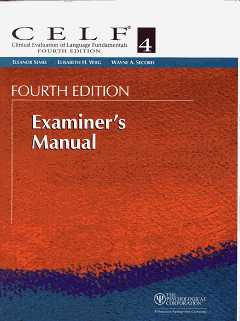
The CELF (Clinical Evaluations of Language Fundamentals) is a tool for the identification, diagnosis and follow-up evaluation of language and communication disorders in students 5-21 years old. The test is administered individually and used by speech and language pathologist, primarily, yet also used by school psychologist, special educators, and diagnosticians. There are three previous editions of this examination. The latest version was redesigned in order to align the examination closer to standards of each state and the Individuals with Disabilities Education Act Amendment of 1977. The new design included an evaluation of a child’s strengths and communication needs, as well as parental concerns and the possible need for assistive technology to develop an IEP. (1)
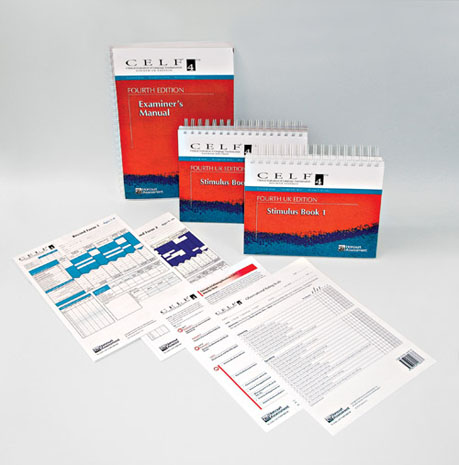
The CELF-4 is designed as a four level assessment process: 1. Identify whether or not there is a language disorder, 2. Describe the nature of the disorder, 3. Evaluate underlying clinical behaviors, 4. Evaluate language and communication in context. The total examination is made up of 19 subtests, a pragmatic profile and observational rating scale. The subtests give a description of language across modalities and content areas. There are two stimulus books and two records forms. One record form is for ages 5-8 years old and the other for 9-21 year olds. The subtests yield separate norm-referenced or criterion reference scores. The following are a list and description of some of the subtests. (1)
The purpose of the Concepts and Directions subtest evaluates the students ability to (a) interpret spoken directions of increasing length and complexity, containing concepts that require logical operations; (b) remember the names, characteristics and order of mention of objects; and (c) identify from among several choices the pictured objects that were mentioned.
The subtest Recalling Sentences subtest evaluates the ability to (a) listen to spoken sentences of increasing length and complexity and (b) repeat the sentences without changing word meanings, inflections, derivations or comparisons (morphology), or sentence structure (syntax).
The Formulated Sentences subtest evaluates the ability formulate complete, semantically and grammatically correct spoken sentences of increasing length and complexity using given words and contextual constraints imposed by illustrates.
The Word Classes subtest evaluates the students ability to understand relationships between words that are related by semantic class features and to express those relationships.
The Sentence Structure subtest evaluates the ability to (a) interpret spoken sentences of increasing length and complexity, and (b) select the pictures that illustrate referential meaning of the sentences.
The subtest Expressive Vocabulary evaluates the ability to name illustrations of people, objects and actions.
The Word Definitions subtest evaluates the ability to analyze words for their meaning features, define words by referring to class relationships and shared meanings, and describe meanings that are unique to the reference or instance.
The Understanding Spoken Paragraphs subtest evaluates the student’s ability (a) sustain attention and focus while listening to spoken paragraph of increasing length and complexity, (b) understand oral narrative and text, (c) answer questions about the content of information given, and (d) think critically to arrive at logical answers.
The Sentence Assembly subtest evaluates the ability to formulate grammatically acceptable and semantically meaningful sentences by manipulating and transforming given words and word groups.
The Semantic Relationships subtest evaluates the ability to interpret sentences that (a) make comparisons, (b) identify location or direction, (c) specify time relationships, (d) include serial order, or (e) are expressed in passive voice.
The Phonological Awareness subtest evaluates the student's knowledge of language structure and their ability to manipulate sounds.
The Familiar Sequences and Number Repetition subtests evaluate the possible effects of memory skills on a student's language disorder and provide additional information on memory ability.
(1)
Evidence 2
Due to strict confidentiality issues pertaining to test results, I am unable to display results as I had hoped. Even taking out the student's personal information is not sufficient enough. So instead, I have included a list of each subtest and the task the student must complete while being evaluated. (2)
Subtest Subtest Task
1. Concepts and Following The student points to pictured objects in response to oral directions.
2. Word Structure The student completes sentences using the targeted structures.
3. Recalling Sentences The student imitates sentences initiated by the examiner.
4. Formulated Sentences The student formulates a sentence about visual stimuli using a targeted word or phase.
5. Word Classes 1&2 The student chooses 2 related words and describes their relationship.
6. Sentence Structure The student points to a picture that illustrates the given sentence.
7. Expressive Vocabulary The student identifies a pictured object, person, or activity.
8. Word Definitions The student defines a word that is presented and used in a sentence.
9. Understanding Spoken Paragraphs The student responds to questions about orally presented paragraphs.
10. Sentence Assembly The student produces 2 semantically/grammatically correct sentences from visually and
orally presented words.
11. Semantic Relationships The student listens to a sentence and selects the two choice that answer a target question
12. Number Repetition 1&2 The student repeats a series of numbers forwards, then backwards.
13. Familiar Sequences 1&2 The student names days of the week, counts backwards, orders other information,
while being timed.
14. Rapid Automatic Naming The student names colors, shapes, and color-shape combinations while being timed.
15. Word Associations The student names words in specific categories while being timed.
16. Phonological Awareness The student rhymes, segments, blends, identifies sounds and syllables in words
and sentences.
The results from each of these subtests forms the "Core Language Score" and the "Index Scores." The Core Language Score is used to make decisions on whether or not a student possesses a language disorder. It is a measure of a student's language performance, based on their general language ability. The Index Score provides teachers, parents, and other special educators with information on the student's strengths and weaknesses in the areas of language structure and content, expressive and receptive modalities, and how the working memory affects linguistic structure and content. The Pragmatics Profile is how the information is displayed, from a parent or teacher, about the student's social language skills. Observational Rating Scales are how the Parent, Teacher, and Student rate the student's classroom interaction and communication skills. (2)
2. "Technical Report." CELF 4. Pearson, 2008. Web. 20 Apr. 2011.
